Snow in Earth System Models Workshop, 17-21 November 2025, Aussois
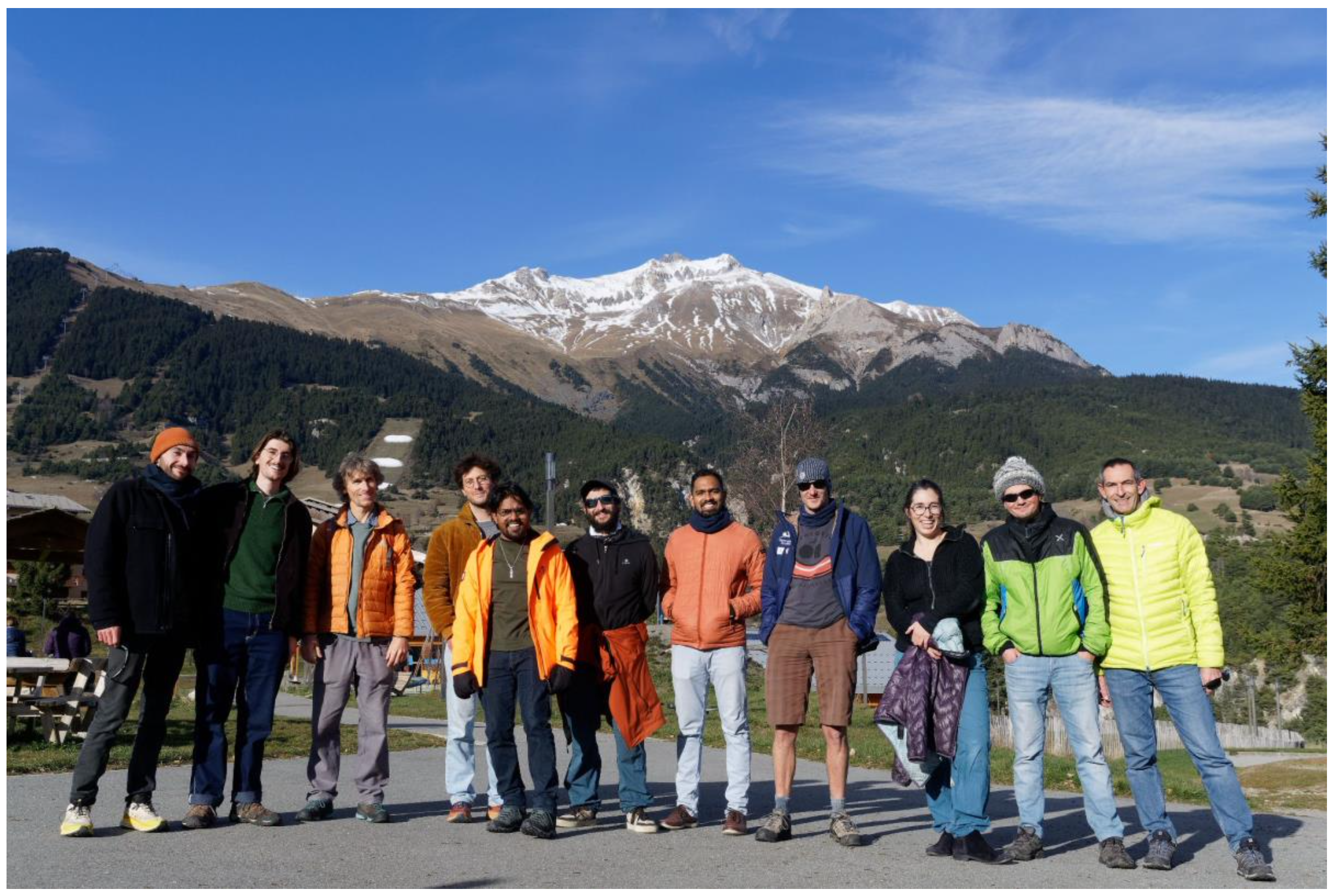
A one-week workshop has been organized with 11 researchers from IPSL, Météo-France and IGE to set up a common framework for snow scheme developments. This workshop has clarified both the scientific requirements and the practical pathways for improving snow representation in Earth System Models (ESMs), with a particular focus on ORCHIDEE within IPSL-CM and SURFEX within CNRM-CM. Across applications ranging from mid-latitude seasonal snow to polar ice sheets, the group converged on a shared view: ESM-oriented snow schemes must prioritize physical consistency, numerical robustness, and computational efficiency, rather than exhaustive process-level details. At the same time, recent advances in observations and detailed snowpack modelling now make it possible to identify a limited but well-defined set of prerequisites that significantly enhance model realism and applicability.
Core developments and current commitments
Based on these priorities, the ongoing development strategy within the group is centered on the use of a common snow scheme for glaciers, ice sheets and continental surfaces with four major axes including (i) improved snow optics through a spectral albedo scheme accounting for snow metamorphism and light-absorbing particles including a coupling with an aerosol scheme (postdoctoral work by Sujith Krishnakumar, LSCE/IGE), (ii) the inclusion of water isotopes in snow to enable process-based attribution studies (postdoctoral work by Sibin Simon, LSCE), (iii) improved representations of fresh snow properties, dry snow metamorphism, compaction and initialization over ice sheets (Philippe Conesa’s PhD, LSCE), and (iv) a more realistic treatment of liquid water percolation, refreezing, and ice layer formation (Glenn Pitiot’s PhD, IGE). Together, these developments will substantially improve the consistency of snow physics across surface types in IPSL- CM and place ORCHIDEE within the leading group of CMIP-class ESMs pursuing advanced, physically- based snow representations.
Evaluation strategy and long-term sustainability
A key outcome of the workshop is the initiation of a coordinated effort to structure a unified evaluation strategy for snow, applicable across surface types and modelling configurations. The group has begun to organize around these questions, with participants, responsibilities, and scientific directions now clearly identified. The envisioned strategy will build on standardized 1D test cases over well-instrumented reference sites (seasonal snow in the French Alps and perennial snow at Dome C, Antarctic), complemented by distributed and coupled simulations at climate scales. Downstream evaluation and validation will further rely on sites from ESM-SnowMIP (Krinner et al., 2018) in North America (Reynolds Mountains) and Japan (Sapporo), as well as on RetMIP (Vandecrux et al., 2020) for Greenland percolation (Dye-2) and accumulation (Summit) zones. These sites, while documented at a more modest level of detail (e.g., lacking vertical profiles or spectral albedo measurements), provide valuable benchmarks for assessing model performance beyond the core test cases. It will progressively include the definition of common evaluation metrics, harmonized data formats, reference archives of observations and control simulations, and the systematic storage of model outputs to support continuous integration. This effort is being developed in close coordination with the ORCHIDEE group, with the objective of remaining aligned with existing practices and ensuring long-term sustainability, including the integration of developments into the main IPSL-CM trunk. To ensure the success and durability of the evaluation framework, the group identified a strong need for dedicated engineering support, for both model evaluation and continuous integration objectives.
Open issues and longer-term perspectives
Finally, the workshop highlighted several important topics that remain largely unaddressed and will require dedicated efforts in the short to medium term : a surface energy balance with differentiated fluxes computed for subgrid tiles depending on surface type, conditions (snow amount in particular), elevation, slope and orientation (following Alleon 2024); the coupling between atmosphere and surface processes for blowing snow (e.g., Amory et al., 2021 ; Vignon et al., 2025); snow–vegetation interactions (e.g. Druel et al., 2019), depth hoar formation and vapor transport (e.g., Brondex et al., 2023); snow on sea ice (e.g., Brivoal et al., 2025), the possibility to simulate on-line the surface mass balance in a common way for ice sheets and glacier; and the closure of the global water budget in fully coupled configurations including the treatment of mass and energy exchanges across the ocean–atmosphere–ice triple interface.
Further information can be found in the workshop report.